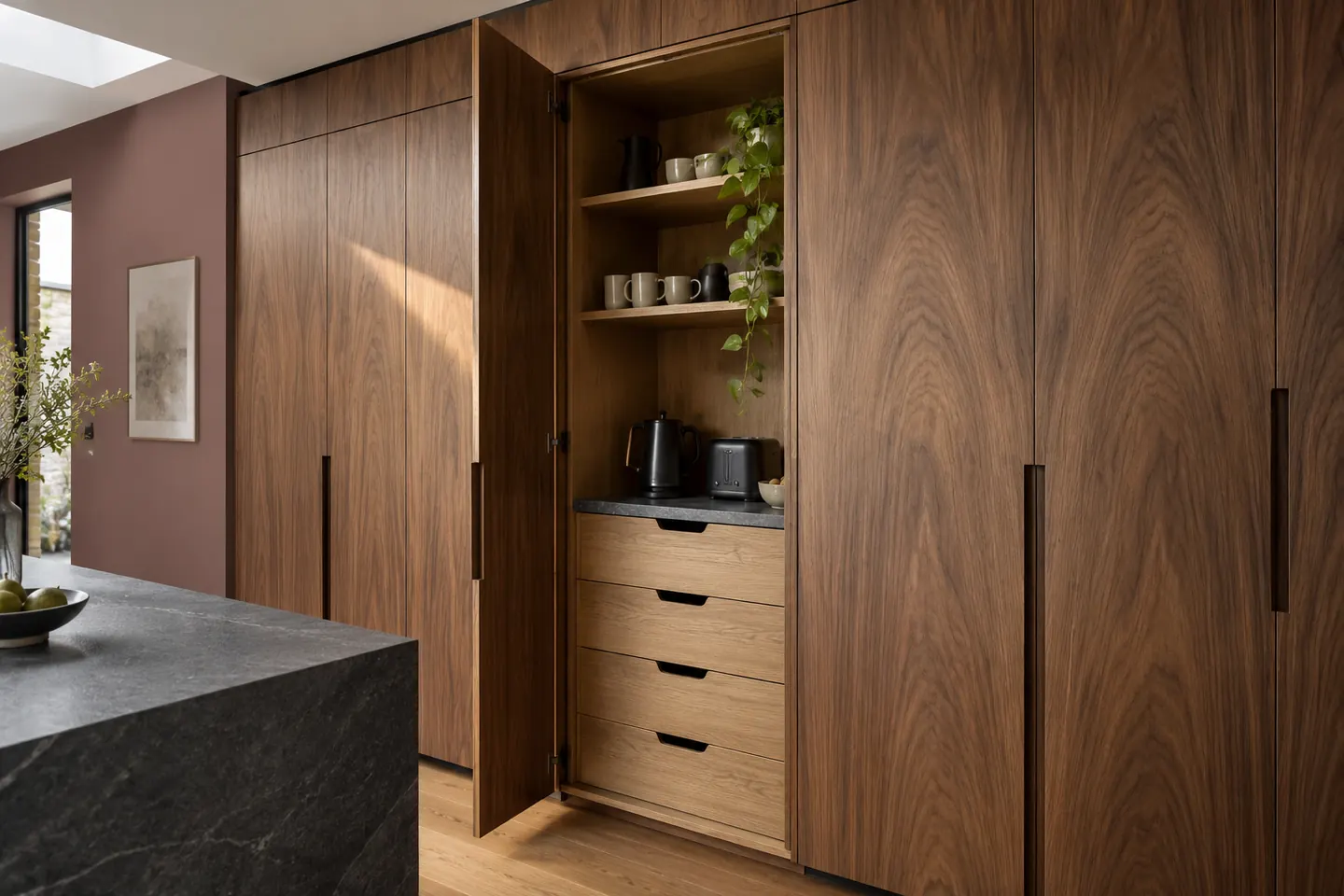
The four layers of a cabinet
1. Carcass. The box. Usually particleboard or MDF, in standard or moisture-resistant grades, with a melamine face. What matters is the grade near water, the thickness, and whether every cut edge is sealed.
2. Door and panel. The face you see. Two-pack, veneer, laminate, thermo-laminate or solid timber — each with a different look, cost and repair path.
3. Edge. Where most cabinets fail first. A thin or poorly bonded edge lets steam and water into the core. Edge thickness and bonding method are worth asking about.
4. Hardware. Hinges, runners, lift systems and internal organisers. The quality difference between entry-level and premium hardware is felt daily, and it is one of the least visible line items on a cheap quote.
Door finishes compared
| Finish | Look | Strengths | Watch for |
|---|---|---|---|
| Two-pack polyurethane | Smooth, seamless painted colour in matt, satin or gloss | Any colour, can be resprayed, sharp modern edges | Edge chips from knocks; gloss shows marks |
| Timber veneer | Real timber grain on a stable core | Warm, architectural, can be recoated | UV colour change near windows; seal around water |
| High-pressure laminate | Solid colours, woodgrains and textures | Very hard-wearing, affordable, easy to replace | Visible edge line; limited profile options |
| Thermo-laminate | Wrapped, often profiled doors | Budget-friendly shaker profiles | Heat from ovens can lift the wrap without heat shields |
| Solid timber | Framed or panelled doors | Traditional character, repairable | Seasonal movement; higher maintenance |
For many North Shore kitchens the answer is a mix: hard-wearing laminate or two-pack in the working zone, and veneer on an island end panel or a tall wall of storage where it can be appreciated without taking daily punishment.
Joinery for period houses
A new kitchen in a Federation or interwar house does not have to be a reproduction. It does have to respect the room.
- Proportion. High ceilings invite tall joinery, but cabinets that stop short of an ornate cornice often look better than ones that crash into it.
- Profile. A simple shaker or flat recessed panel sits comfortably with original skirting and architraves.
- Colour. Deep greens, soft whites and muted greys suit many period interiors; very high gloss rarely does.
- Surface contrast. A timber benchtop, a honed marble, or open shelving on brackets can bridge old and new.
Joinery for apartments and modern houses
Harbourside apartments in Neutral Bay and Cremorne, and newer towers in Chatswood, reward a different approach: handle-less doors, integrated appliances, tall storage that reaches the ceiling to avoid dust-collecting tops, and finishes that bounce light. See apartment and strata kitchens.
Storage, drawn from what you own
Custom joinery earns its cost when it is designed around the actual contents of the kitchen.
- Deep pot drawers rather than base cupboards with a shelf.
- Appliance cupboards with power inside, so the kettle and coffee machine live behind a door.
- Tall pantry pull-outs or internal drawers behind doors.
- Bin and recycling cabinets sized for the household's actual sorting.
- Tray and chopping board dividers near the oven.
- Charging drawer with power for phones and tablets.
Bringing a list of the gadgets, appliances and cookware you use, and a note of what currently has nowhere to go, is one of the most useful things to do before design.
Hardware worth naming
Every hinge, runner and stay is specified by brand and range on the quote. Soft close is standard; what varies is load rating, extension, adjustability and how the mechanism behaves after years of use. Heavy pot drawers need runners rated for the weight they will carry.
Beyond the kitchen
The same joinery language can extend to a scullery, bar, study nook, laundry or living-room wall so the finishes read consistently. See butler's pantries and sculleries and design and layout.
Costs are set out in the 2026 cost bands.
Call 02 5657 4821 or send your kitchen details through.
Scope
Related work
- 01Full Kitchen RenovationsThe whole room rebuilt — services, walls, joinery, stone and lighting — sequenced so the house is without a kitchen for weeks, not months.
- 02Kitchen Design & LayoutPlans drawn to the dimensions of the room you actually have: clearances, sightlines, daylight and where the appliances really fit.
- 04Benchtops & SplashbacksNatural stone, porcelain, solid surface, stainless and timber — chosen for how each one stains, chips, ages and gets repaired.
- 05Butler's Pantries & SculleriesA working room behind the show kitchen — sink, bench, appliances and storage — where the floor plan has space to give.
- 06Apartment & Strata KitchensKitchens in harbourside and walk-up units, planned around by-laws, lift bookings, fixed risers and neighbours through the wall.
Questions people ask before they commit
What is the most durable kitchen door finish?
It depends on the kind of wear. High-pressure laminate resists scratches and knocks very well and is inexpensive to replace. Two-pack polyurethane gives a seamless painted look and can be repaired or resprayed, but it can chip at edges. Timber veneer brings warmth and can be refinished, but it reacts to strong sunlight and standing water. The best choice follows how the kitchen is used.
Is moisture-resistant board worth it?
Around the sink, dishwasher and any integrated appliance that produces steam, yes. Standard particleboard swells when water gets past a failed seal. Moisture-resistant board, properly edged on every face, resists that far longer. It is a modest cost for the cabinets most exposed to water.
Can new joinery match the character of a Federation house?
It can. Shaker-style or simple recessed-panel doors, painted finishes in heritage-appropriate colours, timber benchtops or open shelving, and details such as a plinth or cornice that echo the house's joinery all help a new kitchen sit comfortably in a period home.
How long does custom cabinetry take to make?
Manufacture typically takes several weeks after drawings and selections are signed off, longer for timber veneer or specialist finishes. Installation of the cabinets themselves is usually a matter of days. The kitchen is not demolished until the joinery is ready.