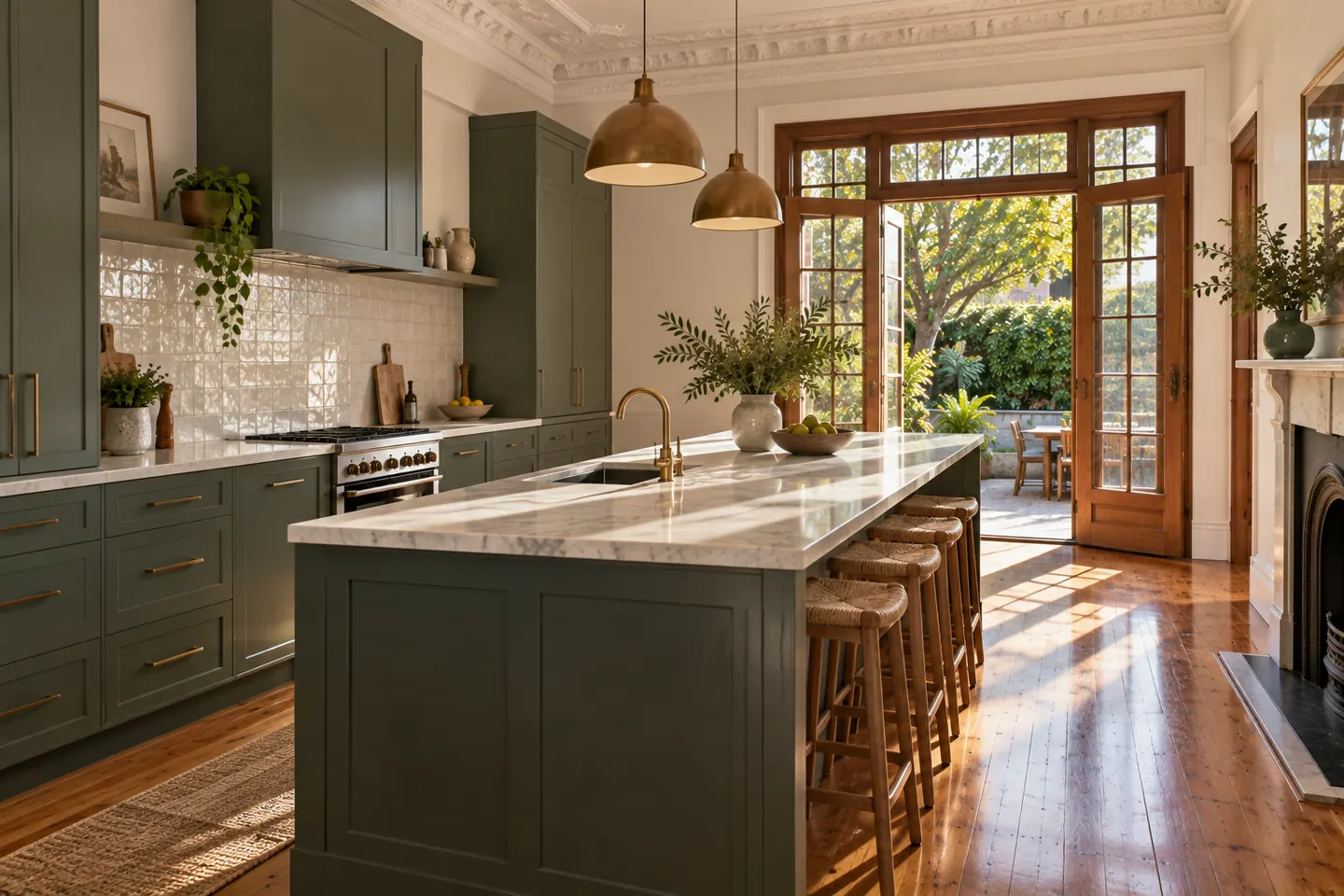
The Mosman house
Mosman's residential streets are dominated by Federation and interwar houses: brick and sandstone foundations, tuckpointed or rendered facades, terracotta roofs, verandahs and deep eaves. Large parts of the suburb sit within heritage conservation areas, and some individual houses are listed heritage items.
In most of these homes the original kitchen was a service room at the rear, sometimes replaced by a skillion or lean-to addition decades later. Many were renovated once already, in the 1970s or 1990s, with a layout that turned its back on the garden.
That history makes the typical Mosman kitchen brief quite specific: bring the kitchen into the everyday life of the house, connect it to the outdoors, and do it without making the rear of a heritage house look like an apartment block.
Heritage without drama
Mosman Council's heritage controls are concerned mainly with what the public sees. For a kitchen project, that generally means:
- Internal work — new joinery, benchtops, services and finishes inside the existing walls — is usually straightforward in a conservation area.
- Rear external changes — larger openings, bi-fold or stacker doors, skylights — may need assessment depending on visibility and the property's listing.
- Listed heritage items can have internal fabric of significance, so assumptions about exempt work should be checked first.
These questions are raised at the first visit rather than after the design has been drawn around a new opening that may not be permitted.
Slope, stairs and the harbour
Much of Mosman falls steeply toward Middle Harbour, Mosman Bay, Balmoral and Clifton Gardens. Homes around Beauty Point, Balmoral Heights and the harbour foreshore can sit well above or below the street, reached by long flights of steps or tight driveways.
That changes the logistics of a kitchen renovation:
- Stone slabs and long panels need a path from the truck to the room. Weight and turning space are checked before a waterfall island is specified.
- Skip bins and parking in narrow streets may need council permits and careful timing.
- Demolition waste is carried rather than wheeled.
None of this stops a good kitchen being built. It does belong in the program and the price from day one.
Materials that suit the houses
Mosman kitchens tend to reward materials with depth and age:
- Honed marble or quartzite on an island, accepted for its patina
- Painted shaker or flat-panel joinery in colours that sit well beside original timberwork
- Timber veneer on tall storage walls that face a living room
- Handmade or glazed tiles on a splashback
- Brass or aged-bronze tapware, specified for water quality and cleaning
In north-facing rooms that open to the garden, UV-stable materials such as porcelain and quality laminate hold their colour better than some timbers. See benchtops and splashbacks and cabinetry and joinery.
The scullery question
Larger Mosman houses often have room for a scullery behind the main kitchen, frequently in the footprint of an old laundry or rear service room. It keeps an open-plan kitchen facing the harbour or the garden clear during entertaining. See butler's pantries and sculleries.
Flats and apartments
Mosman is not only houses. Interwar flat buildings and 1960s–70s walk-ups line streets near Military Road, Spit Junction and Mosman Junction, and there are harbourside apartment buildings near the water. Kitchens in these buildings follow strata rules on approvals, hours and access. See apartment and strata kitchens.
Asbestos in older renovations
A Mosman house may be more than a century old, but the risk usually lies in the last renovation. Kitchens refitted before about 1990 can contain asbestos sheeting behind splashbacks, in eaves of rear additions or in old vinyl flooring. Testing before demolition is standard practice.
Nearby
Also serving Balmoral, Beauty Point, Clifton Gardens, Spit Junction and the Mosman side of Cremorne. See Neutral Bay and Cremorne next door.
Costs: see the 2026 cost bands, which note why harbourside access tends to push jobs toward the upper range.
Call 02 5657 4821 or send your kitchen details through.
Questions people ask before they commit
Does a Mosman heritage conservation area affect a kitchen renovation?
Mostly it affects what can be seen from the street and the public domain. A purely internal kitchen renovation is rarely a heritage issue. It becomes one when the work reaches the outside — new or enlarged rear openings, skylights, roof changes or additions — or when the house is itself a listed heritage item. Those questions go to Mosman Council's planning controls before design is fixed.
Why do Mosman kitchen renovations often cost more?
Access is the biggest reason. Steep blocks, long stairways, limited street parking and narrow driveways add labour to every delivery, from stone slabs to skip bins. Period houses also bring more making good, uneven floors and walls, and a higher expected standard of finish.
Can the kitchen open onto the garden or the view?
Often, and it is one of the most rewarding changes in a Mosman house. Widening a rear opening or adding glazed doors is external and structural work, so it needs engineering and a check of whether consent is required, especially in a conservation area or on a heritage item.
What about kitchens in Mosman flats?
Mosman has many interwar and post-war flat buildings. A kitchen renovation in one generally needs owners corporation approval under the strata by-laws, and walk-up access means materials are carried in by hand. Stone and panel sizes are checked against the stairwell before ordering.